
The CoCo's 3rd Time is a Charm
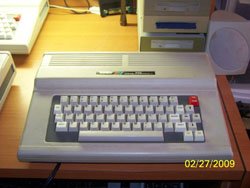
Greetings retro-fans, and welcome to another month of CoCoLicious! I hope everyone had a great time during the holidays and got to spend some quality time with your families and the retro-machine of your choice. Last month, I finally coughed up the second part of my three-part series about the TRS-80/Tandy Color Computer. I would like to thank several people at the outset: Nick Marentes, Boisy Pitre, Dennis Bathory-Kitsz, Mark Marlette, and Frank Swygert. Without their generous donation of information and knowledge, this article would've been much shorter and much less informative. During the production of the Color Computer series, there have been a number of differences, not only in model numbers, but also, board layouts, upgrade paths, and overall design philosophy in some cases. This month should provide a bit of a respite from all of that, but, there's still quite a bit to go over, so, on with the sho....err article!
Computing in the mid 80's
There were lots of changes in the computer industry since the 1980 roll-out of the Radio Shack TRS-80 Color Computer (affectionately referred to as the CoCo) by mid-1985. Bill "the Incredible Huxtable" Cosby was pushing the Ti-99/4a; Radar O'Reilly and most of the M.A.S.H. cast was mugging for the IBM Personal Computer; Dick Cavet was doing Apple ads; William "Capt. Kirk" Shatner was trying to sell Commodores; Alan Alda broke from the rest of the M.A.S.H. cast and was hawking Atari equipment; and busty spooky chick Elvira was in print selling something called LMBS. With that much star power, was there anyone left to help sell the Tandy/TRS-80 line? Well, none other than Isaac "I, Robot" Asimov made numerous print ads for the 'Shack's computer lines - virtually all of them. Bill "The Incredible Hulk" Bixby made quite a few TV commercials. Celebrities mugging for computer companies weren't the only changes, either. Apple, Commodore, IBM and Atari all began marketing the first 16/32-bit computers in this time frame as well. Atari had the ST line, Commodore released the Amiga and Apple was making the Macintosh - all based on the Motorola 68000 series. Some of you may be asking "What does this have to do with the CoCo?" and that would be a legitimate question. While the rest of the computer industry fought amongst themselves with computer models based on the Motorola 68000 series chip, Tandy continued walking their path on three fronts.
First, Tandy invested heavily in the MS-DOS machines with the Tandy 1000 series of computers. With architecture similar to, but not tied to the fate of the PCjr, the 1000 line was a critical and commercial success. There were a number of other lines including the 2000, 3000 & 4000 that helped Tandy remain a computer powerhouse into the early 1990's.
Second, Tandy continued with the Model III/IV support - even though it was dwindling in sales and software support by this time.
Third, while From 1982 to 1985, several high profile magazines stated that the CoCo was dead (it's notable that those publications 'died' long before the CoCo did), Tandy decide to march on with the very successful Color Computer line. Which leads us to...
The Deluxe Color Computer
One very interesting marker on the pathway to the CoCo 3 is the Deluxe Color Computer. Several Getting Started With Extended Color BASIC manuals that shipped during the Color Computer 2 era made reference to a Deluxe Color Computer, but for many years the machine was known mostly through documentation, recollections and a handful of references from people who had been involved with it.
My first knowledge of the machine came from a post to the CoCo mailing list called Remembering the Deluxe Color Computer. The specifications remembered for the machine included:
- Double-speed operation
- A real RS-232 serial port with UART
- Dedicated sound hardware
- A RAM drive
- Improved video capabilities
- True lowercase characters
- Additional BASIC commands
- 64K of RAM
At the time the original version of this article was written, the Deluxe was still something of a ghost machine. We knew Tandy had worked on it, we had descriptions of its features, and we had recollections from people who had seen or worked with the project. What we did not have was the sort of photographic evidence now available.
2026 UPDATE - A DELUXE COCO SURVIVES
That picture has changed considerably. Brian Wieseler owns one of the surviving Deluxe Color Computer development machines and has generously granted permission to reproduce photographs of it here. The surviving machine gives us a rare look at a branch of Color Computer development that Tandy abandoned before it ever reached Radio Shack shelves.
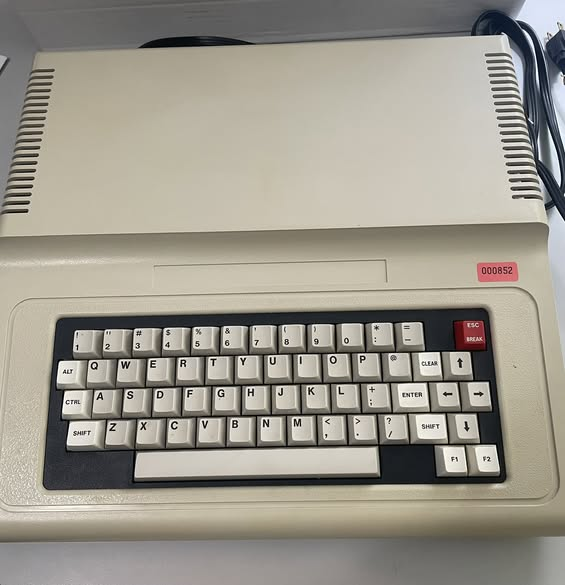
Surviving Deluxe Color Computer development machine. Photograph courtesy of Brian Wieseler, used with permission.
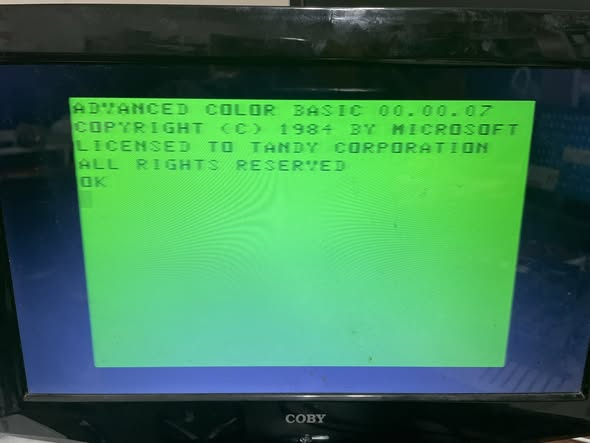
Advanced Color BASIC 00.00.07 running on the surviving Deluxe Color Computer. Photograph courtesy of Brian Wieseler, used with permission.
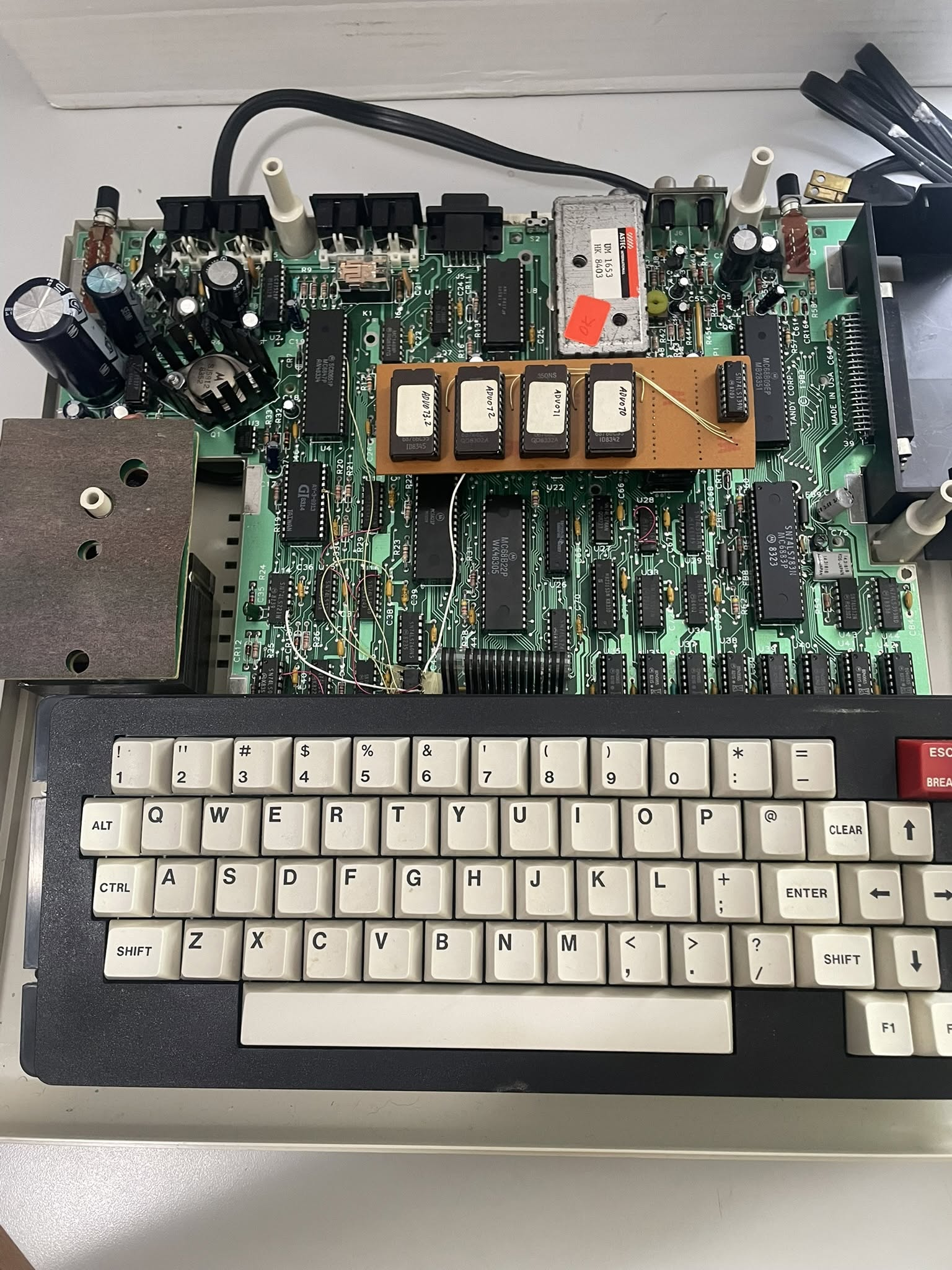
Inside the surviving Deluxe Color Computer development machine. Photograph courtesy of Brian Wieseler, used with permission.
Brian Wieseler: During the CoCo 2 era Radio Shack started the development of the next CoCo. What they created was the Deluxe Color Computer. There were a dozen or so built and sent out to developers and were to be returned to Radio Shack. All were returned except for three that we know of. Boisy Gene Pitre has two and I have the one that Robert Kilgus had.
It was housed in a CoCo 1 case because they were still working on making the board smaller. It also has a CoCo 3-like keyboard but with the black body. The Deluxe had a dedicated AY3 sound chip and a serial chip with 9-pin D plug on the back.
It had Advanced Color BASIC along with a handful of new commands and a RAM drive. If you had a disk controller in the cartridge slot it would prompt with press 1 for DOS or 2 for BASIC. If you pressed 1 it would boot into OS-9 if there was an OS-9 disk in the floppy drive.
Excerpted from Brian Wieseler's September 2026 #SepTandy post. Used with permission.
The exterior is immediately interesting because this particular development machine is housed in a CoCo 1-style case but uses the later keyboard layout that would become familiar on the CoCo 3, including the F1 and F2 keys. Inside, the machine is unmistakably a development system rather than an ordinary production CoCo. The surviving hardware also carries prototype ROMs on a daughterboard.
Deluxe Color Computer demonstration
Advanced Color BASIC
Perhaps the most fascinating evidence comes from simply turning the machine on. The surviving prototype boots ADVANCED COLOR BASIC 00.00.07, with a 1984 Microsoft copyright and Tandy licensing message. That is physical evidence that the Deluxe project had progressed beyond a list of proposed hardware features: Tandy was also developing a new software environment for it.
According to information supplied by Brian Wieseler about the surviving machine, its Advanced Color BASIC ROM contains additional commands and the system can make part of its memory available as a RAM drive. He also reports that, when a disk controller is installed, the machine can prompt for DOS or BASIC at startup, with another startup choice associated with OS-9. Those details are best treated as observations and documentation of this surviving development machine rather than specifications for a production model that never existed.
This is particularly interesting in hindsight because the eventual CoCo 3 would also preserve the Microsoft BASIC foundation while extending it for new hardware. The Deluxe therefore shows that Tandy was already experimenting with the idea of advancing both sides of the Color Computer at once - hardware and BASIC - well before the CoCo 3 reached production.
What Was the Deluxe Supposed to Be?
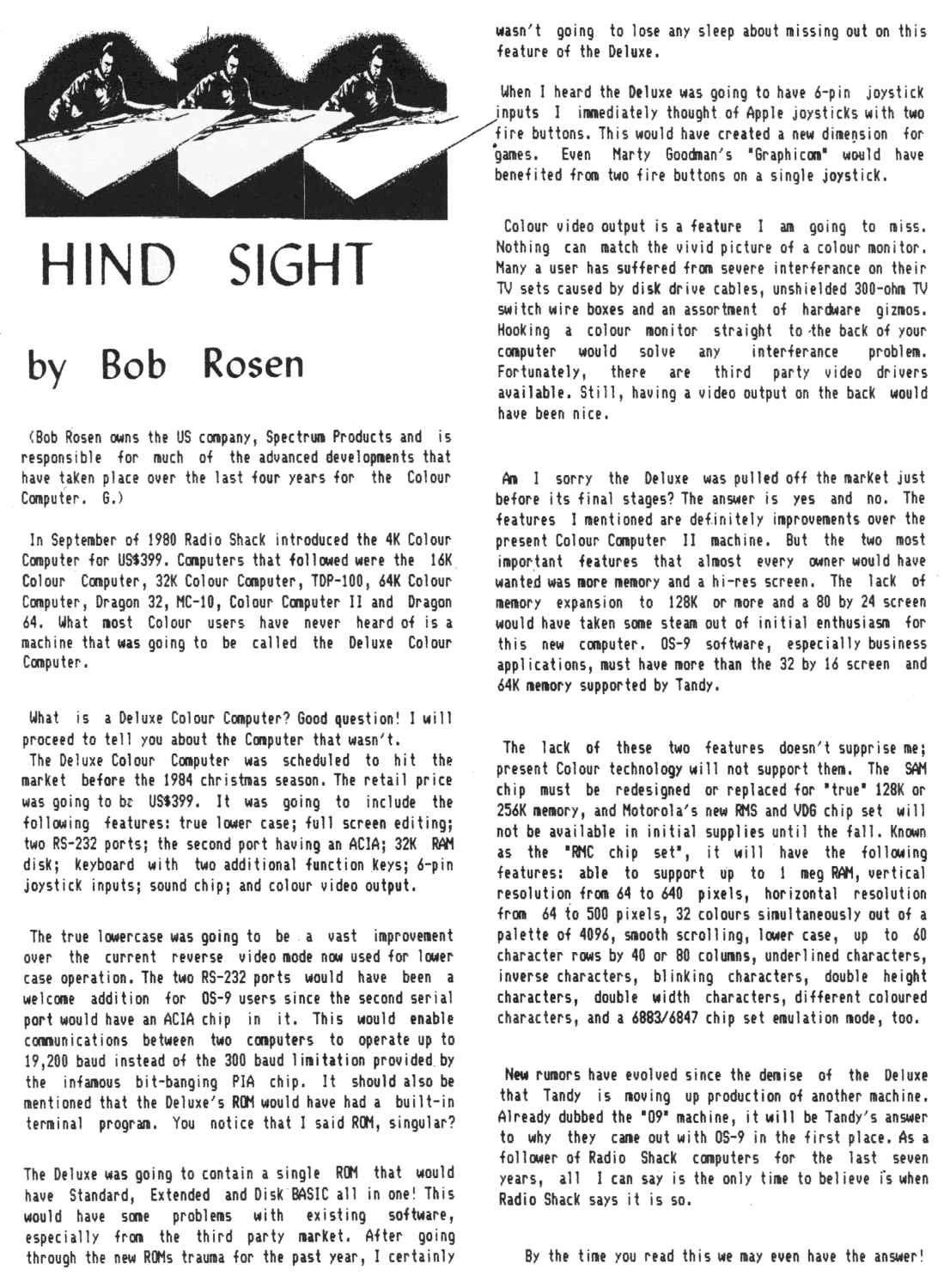
While researching the original article, I came across information posted on Nick Marentes' website. In a 1985 issue of The Australian Rainbow, Rob Rosen of Spectrum Projects discussed the Deluxe Color Computer and the direction Tandy and Motorola were exploring. That material also mentioned Motorola's Raster Memory System, or RMS, which becomes important later in the story.
Nick Marentes also provided information from an interview he conducted with Mark Siegel for his book CoCoNuts. Siegel, one of the central figures behind the CoCo 3, remembered the Deluxe as a next-generation Color Computer 2 project that was cancelled before production.
Nick: Do you have any "nightmare" stories to tell of your Color Computer 3 development days?
Mark: My biggest disappointment was the Deluxe Color Computer not coming to market. It was a pretty cool next generation Color Computer 2 but Motorola ran short of video/memory controllers and Tandy had a choice of where to put them and they chose the cheaper Color Computer 2.
Nick: What were the specifications of the Deluxe Color Computer?
Mark: It had a GI sound chip, a real UART, 64K of memory (in Disk Basic, 32k was used as a RAM drive). It had a 40 column display with a 320x200 mono graphics mode, the Color Computer 3 keyboard and some cool new Disk Basic commands. The OS-9 for it was very nice.
Nick: How was the 40 column display and 320x200 mode generated? The Motorola 6847 video chip used in the Color Computer couldn't produce this.
Mark: My recollection is fuzzy on this but I think we added an additional video controller to the unit. But since it had to go out the RF it was restricted to 40 columns.
Nick: Was it to have a restyled case?
Mark: It was a Color Computer 1 case with some work on the back and it was painted black.
Nick offered the following commentary on the case issue:
Nick Marentes: I think black was the default color of the moulded plastic and the final production models were to be painted some other color (probably silver again). The original CoCo 1 was actually black when you scraped the silver paint off.
A Missing Link - But Not the CoCo 3
The surviving Deluxe makes one thing much clearer: Tandy's path from the CoCo 2 to the CoCo 3 was not a single clean jump. The company had already experimented with a faster and more capable Color Computer that combined 64K RAM, dedicated sound, a UART, improved video, a RAM drive, a better keyboard and an expanded BASIC environment.
It is still important not to turn the Deluxe into something it wasn't. It was not simply an early CoCo 3, and the surviving development machines do not prove that every proposed feature would have appeared in a production Deluxe. What they do prove is that the project got far enough for real hardware and real firmware to exist.
In hindsight, cancelling the Deluxe may have helped clear the way for a more substantial redesign. Instead of merely extending the CoCo 2 again, Tandy eventually produced a machine centered around the GIME, 128K of standard RAM, 512K expansion, RGB output and dramatically more capable graphics. But the Deluxe deserves its place in that story because it shows that many of the ideas associated with a more advanced Color Computer were already being explored years earlier.
And that leads directly into another piece of the puzzle: what Tandy and Motorola were considering for the video and memory architecture of a truly next-generation Color Computer.
Rumors, Rumblings and Ruminations
Now, as early as mid-1985 rumblings of a new CoCo began to hit the street. Lonnie Falk, editor and publisher of the Rainbow Magazine stated as much in an August 1985 editorial (and three more times thru July '86) discussing some of the new computers hitting the market from the likes of Atari and Commodore. It's no secret that most of the computer industry didn't take the CoCo line as a serious competitor. One look at the Chiclet keyboard of the CoCo1 would make most people walk right on by. Many also thought the battleship grey case was hideous looking as well. Few looked into the internals of the machine to see the potential.
At least one CoCo enthusiast shows affection for the Chiclet keyboard:
Nick Marentes: Ironic that the Chiclet keyboard has now become the preferred keyboard seen on all Mac's and PC laptops. Bring back the REAL keyboard again I say!!
When the white CoCo1 and subsequently the CoCo2 were released, the CoCo got a little more respect. With a smaller footprint, better keyboards, and a better looking case,
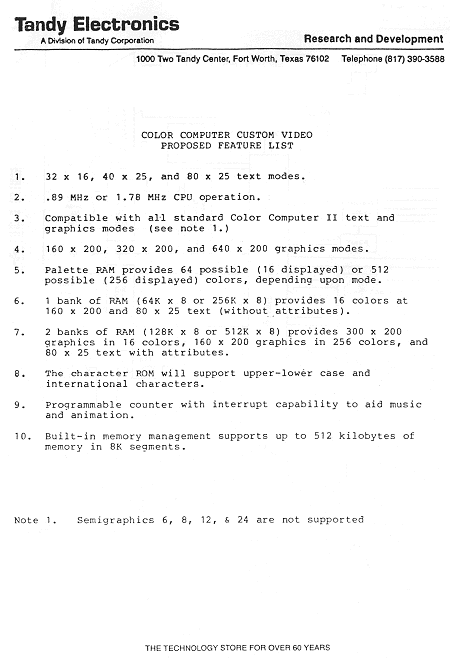
it indicated to many that Tandy was serious about building an improved CoCo. Below is an internal Tandy R&D document (again, courtesy of Nick Marentes) detailing some of the video features they were trying to provide for an even better Color Computer.
 .
Before the GIME - Motorola's Raster Memory System
2026 UPDATE: The RMS mentioned above deserves much more than a passing reference. Motorola's Raster Memory System was an ambitious video and memory-management chipset intended for systems using processors including the 6809E and 68000. Contemporary technical coverage described it as essentially two systems in one: a powerful new graphics architecture and a compatibility-oriented "Machine 2" mode capable of emulating much of the familiar CoCo MC6883 SAM / MC6847 VDG environment.
The proposed RMS specifications were remarkable for a mid-1980s 6809-class computer: up to 1 megabyte of memory, horizontal resolutions from 64 through 640 pixels, vertical resolutions from 64 through 500 pixels, and 32 colors selected from a palette of 4096. It also supported programmable character sets, smooth horizontal and vertical scrolling, a virtual display larger than the visible screen, text attributes such as underline, flash and inverse video, and game-oriented features including priority and collision detection.
Perhaps the most tantalizing RMS feature was hardware object support. Motorola's documentation described eight independently positioned "true objects" with X/Y positioning, priority and collision status - in practical terms, sprite-like hardware that could relieve the 6809 of work that the production CoCo 3 would ultimately have to perform in software. The design also included real-time beam-position input and output functions useful for devices such as a light pen.
RMS was not merely an unrelated graphics experiment that happened to use a 6809. Its compatibility mode was specifically described in contemporary coverage as a "CoCo mode." Familiar CoCo functions and memory behavior were reproduced through RMS registers, while the new architecture added capabilities far beyond the original VDG/SAM combination. That makes RMS an important part of the story of what a next-generation Color Computer might have looked like.
The Rumored Model 09
The connection becomes more interesting in contemporary reports from UnderColor. In 1985 the magazine reported rumors of a new Tandy machine referred to as the Model 09. The rumored system was described as OS-9 only, without a BASIC ROM, and with software-selectable 1 or 2 MHz operation. UnderColor was careful to state that it could not independently validate these Tandy rumors, so the Model 09 details should be treated as contemporary reporting rather than established production specifications.
According to that report, RMS had originally been associated with the proposed machine, but Motorola's second silicon revision came back with serious problems and the chipset was reportedly delayed six to nine months. With the new Tandy computer expected before RMS could be ready, the magazine reported that RMS had been dropped from the project.
The most intriguing part of the report was what supposedly happened next: UnderColor stated that Motorola engineers left the RMS project to devote their efforts to a custom VLSI graphics chip for the Model 09. That statement is especially significant in hindsight because the production Color Computer 3 would appear the following year built around exactly the sort of custom graphics, interrupt and memory-management device the earlier CoCos lacked.
Nick Marentes: The story I heard is that when Motorola canned the RMS (or couldn't get it to work reliably), some of the designers left and went to work on the GIME for Tandy. That's why I suspect, the specs of the RMS is very similar to the GIME. If anything, the GIME is a cut down version of the RMS design. Tandy didn't do the designing. It was contracted by a chip firm.
RMS, GIME - and What We Can Actually Say
It is tempting to draw a perfectly straight line from RMS to the Model 09 and finally to the GIME, but the surviving evidence does not justify calling RMS a prototype GIME or declaring that the Model 09 simply became the CoCo 3. The strongest contemporary Model 09 account was explicitly presented as rumor, and some later recollections differ in detail. What can be said is that Motorola was developing an advanced 6809-compatible graphics and memory architecture, Tandy was investigating a substantially more capable Color Computer, RMS encountered development trouble, and contemporary reporting linked engineers from that effort with a custom VLSI graphics project for Tandy.
The comparison is nevertheless fascinating. Both RMS and the later GIME addressed several of the same fundamental problems: backward compatibility with the existing CoCo architecture, access to substantially more memory, higher-resolution displays, programmable colors, scrolling and moving more system/video functions into custom logic. RMS was much more ambitious in several areas - particularly its 4096-color palette space and hardware objects - while the production GIME omitted dedicated sprite and sound hardware in favor of a design Tandy could put into an affordable Color Computer.
So RMS is best viewed not as a "lost GIME," but as a revealing look at the technological neighborhood in which the CoCo 3 was conceived. It shows just how ambitious Motorola and Tandy's next-generation thinking had become - and helps explain why the GIME represented such a dramatic break from the VDG/SAM architecture of the CoCo 1 and CoCo 2.
If RMS did not make it into a production Color Computer, what exactly did Tandy pull out of its hat for the CoCo 3?
Enter The GIME
The hardware of the CoCo1 and CoCo2 were identical in functionality; while the hardware changed quite radically over their life spans the two machines were functionally the same. Tandy realized that to compete with some of the newer computers hitting the market, the new Color Computer needed to be able to show off better graphics; the previously shown internal memo reflects that. The new CoCo also needed to be able to address more memory, and if the RMS chip wasn't to be included to address these issues, something else needed to be.
The Advanced Color Video Chip or more commonly called the Graphics Interrupt Memory Enhancement chip, or GIME, is an ASIC chip that Tandy had developed to handle graphics and memory functions for the new CoCo, bringing the following enhancements:
- 32x16, 40x24, or 80x24 character text screens
- 8 foreground and 8 background colors, underline, and blink.
- Up to 16 simultaneous colors (programming tricks permit more)
- Palette of 64 colors
- The GIME provides TV, composite video monitor, or an analog RGB monitor connections
The GIME combined the functions of the 6847 VDG and the 6883 SAM ' emulating both chips, providing the above mentioned text screens in addition to all of the graphics modes of the CoCo2, as well as 320x192, 640x192 and 640x225 hi-res graphics screens.
The GIME also provides system timing and device selection, refresh and multiplexing for the RAM, and contains an MMU which allows RAM expansion from 128k to 512k. The new chip did remove all of the semi-graphics modes, as mentioned in the memo.
What the GIME Actually Does
2026 UPDATE: With considerably more technical documentation available today, the GIME is better understood as the heart of the CoCo 3 rather than simply a replacement video chip. In addition to generating the new video modes, it provides system timing, DRAM refresh and multiplexing, device selection, programmable timers, interrupt control, palette registers and the machine's Memory Management Unit (MMU).
The 6809 still has a 16-bit address bus and can therefore see only 64K at one time. The GIME solves this by dividing the CoCo 3's physical memory into 8K blocks. Eight of those blocks are mapped into the CPU's 64K logical address space at any given time. In a 512K machine there are 64 physical 8K blocks available to the MMU. This bank-switching system is one of the most important architectural differences between the CoCo 3 and the earlier Color Computers.
The GIME's video hardware is also considerably more flexible than the simple mode lists printed in most advertisements suggest. At the hardware level, high-resolution modes can use several horizontal resolutions and vertical timings including 192, 200, 210 and 225 lines. Super Extended Color BASIC exposes only part of what the hardware itself can do.
At the 2005 CoCoFest, a very rare bird was put on display: a CoCo 3 prototype board. As you can see, this was NOT a small board; it contained an integrated floppy controller and discrete logic circuitry that would later be condensed into the GIME chip.
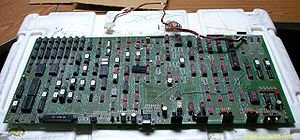
(CoCo 3 prototype shown at the 2005 CoCoFest in Chicago)
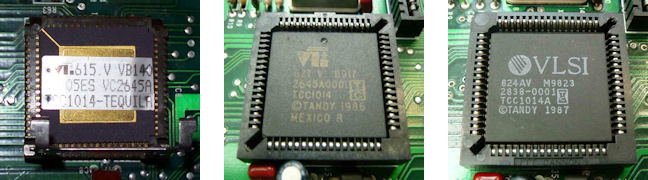
(Prototype, 1986 & 1987 GIME chip images provided by Nicholas Marentes)
In addition to the GIME, there were a couple of other changes that benefitted the CoCo 3. First, the CoCo 3's display was enhanced to provide true lowercase characters at 40 & 80 column widths (really provided by the GIME). Second, the CoCo 3 was capable of running at 1.78MHz without loss of display ' a problem that plagued some earlier machines. Third, the CPU was changed to the 68B09E and the PIA was upgraded to 68B21 ' both which were rated as 2MHz parts. Finally, the CoCo 3 got an enhanced keyboard ' a full travel, 57 key enhanced keyboard. The additional keys are F1, F2, ALT& CTRL.
One of the biggest benefits of the GIME was that the CoCo 3 could not only support 128k RAM, but, there was now a 512k RAM upgrade as well. As you might have guessed, the extra RAM was welcomed by many people including OS-9 users and gamers. I don't have a full grasp of OS-9 by any stretch; what I do know is it is a multi-user, multi-tasking operating system introduced on the original Color Computer. With the CoCo 3, they added windowing capability. This flexibility and power of OS-9 however, is a subject for an upcoming series of articles where I'll chronicle my learning experience with OS-9/NitrOS-9.
2026 UPDATE: OS-9 Level II deserves considerably more credit than I gave it in the original article. The GIME's MMU made the CoCo 3 particularly well suited to Level II because the operating system could make productive use of banked memory beyond the 6809's 64K logical address space. Multitasking, multiple processes, windowing and the larger memory configurations turned the CoCo 3 into a far more capable OS-9 machine than its predecessors. NitrOS-9 has carried that operating-system lineage forward, including builds optimized for the HD6309.
When the original version of this article was written, the GIME was still something of a black box to most CoCo owners. The prototype board above, surviving technical documentation, later FPGA implementations and years of investigation by the CoCo community have since filled in much more of that picture. Just as importantly, the once very real fear that a failed GIME could permanently sideline a CoCo 3 has changed dramatically.
2026 UPDATE - THE GIME CAN BE REPLACED
Fortunately, that concern did not age well - and that is a very good thing. Gary Becker's work implementing the CoCo 3 in programmable logic through the CoCo3FPGA project eventually contributed to a practical FPGA recreation of the GIME. Working with Ed Snider, Becker developed the Verilog implementation while Snider designed and built the GIME-X hardware.
GIME-X demonstrated that the custom chip at the center of the CoCo 3 was no longer an irreplaceable black box. More recently, GIME-Z has provided another FPGA-based GIME replacement approach, including expanded memory addressing and faster operating modes. A dead original GIME is therefore no longer automatically the death sentence for a CoCo 3 that it appeared to be when this article was written in 2013.
The CoCo 3 Arrives!!!
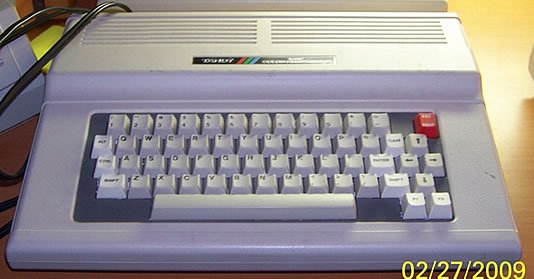
Date: July 30th, 1986
Place: Waldorf-Astoria Hotel, New York City
Event: Tandy unleashes the Color Computer 3 on an unsuspecting world.
Well, okay, maybe not unsuspecting, but, most did not anticipate the improvements Tandy gave to the CoCo 3. The September 1986 issue of the Rainbow Magazine was full of very positive commentary from CoCo luminaries from Lonnie Falk to Marty Goodman to Steve Bjork on the new hardware. Probably rightly so; below are the official specifications of the Color Computer 3 at launch time:
Text display: 32x16 compatibility mode; GIME high-resolution text modes commonly used as 40x24 and 80x24 text screens
Graphics: GIME modes from 128 through 640 pixels horizontally, with 192, 200, 210 and 225-line timings available at the hardware level; Super Extended BASIC exposes a subset of these modes
Colors: 64-color palette; up to 16 palette registers active in standard GIME modes
Video output: RF, composite video and analog RGB
Storage: Cassette and floppy at launch; hard disks and other mass storage available through later third-party hardware
Operating system / languages: Extended Color BASIC, Disk Extended Color BASIC with Super Extended Color BASIC enhancements, and OS-9 Level II
First released: July 1986
CPU: Motorola MC68B09E
Clock speed: approximately 0.895 MHz normal / 1.79 MHz high-speed mode (the MC68B09E itself is a 2 MHz-rated part)
Data bus width: 8 bit
CPU address space: 16 bit / 64K logical address space
Memory: 128K standard; official Tandy expansion to 512K. Third-party designs later extended CoCo 3 memory beyond the factory configuration.
ROM: 32K internal ROM
Interfacing: Cassette; serial bit-banger; two joystick ports; analog RGB; RF; composite video; RCA audio; cartridge/expansion slot
The CoCo 3 was compatible with almost all CoCo 1 & 2 hardware and software. While the CoCo 3 had the same limitations of the CoCo2 regarding the lack of a 12vdc circuit, as long as a multipak interface was used, this was not an issue. Also, if you used an RGB monitor, any software for the CoCo 1 & 2 that relied on artifact colors would be shown only in black & white. There were patches made to correct this in many instances, however, not all software was fixed.
One thing you may notice missing in those specs is a dedicated sound chip. Most computers by the mid-80's had sound hardware integrated into their design - either available on the motherboard itself or as an add-on card. This is yet another example where CoCo enthusiasts still take Tandy to task. Yes, the 6809 is a very powerful 8-bit CPU. However, it just can't do all things at once. Having dedicated sound hardware (and sprite hardware for that matter) would've made the CoCo 3 a bona fide powerhouse computer. The downside would've been the cost. Here's what Mark Siegel had to say:
Nick: Why wasn't additional sound hardware included in the design?
Mark: I had been given a choice in the production budget that I could put in either a sound chip or a UART. Not enough money for both. So I opted for neither. I put in programmable timers and an interrupt controller. That way I could do both in software.
One immediate difference upon powering up a CoCo 3 was the boot screen. It was still the familiar black text on nuclear green, but, the boot message added a line about Microware being involved in the licensing of Microsoft's BASIC interpreter for the CoCo 3. Here's the story behind the boot screen:
Nick: Why did Radio Shack elect to use Microware for the 3's enhanced BASIC?
Mark: It wasn't Radio Shack that elected to do that, it was me. Microsoft told Tandy that any new Color Computers had to have its BASIC in it or else!! And that they would not make any changes or supply source code. So I provided Microware with my disassembly of the code and a list of new commands and features and had them do it.
My understanding of what is happening during the boot process is this:
Microsoft's unmodified BASIC interpreter is stored in the CoCo 3's ROM. During boot up, the BASIC code in ROM is copied to RAM which is then patched by Microware's updated code. This is how the additional commands Mark Siegel wanted in DECB 2.1 & Super Extended Color Basic are accessible.
Microsoft BASIC - With Microware Surgery
2026 UPDATE: The CoCo 3 did not simply throw away the software foundation of the earlier machines. Its BASIC environment remained layered on the familiar Color BASIC, Extended Color BASIC and Disk Extended Color BASIC lineage. Super Extended Color BASIC added the CoCo 3-specific commands and support needed for the GIME's enhanced text, graphics and memory features. That compatibility-minded approach is a major reason so much earlier CoCo software continued to run on the new machine.
During the first run production, some problems were discovered in what is now known as the 1986 GIME chip. Now, it's a matter of conjecture as to how serious the problem is, or even if it is a problem. Certain code causes sparkly type artifacts on the screen. Some say there's an issue with booting into NitrOS-9 using a machine with the '86 GIME chip. The 40 or 80 column screen tends to cause the computer to hang in the boot process.
Some programmers feel that it's a just a programming issue, others feel that the hardware is not performing as it was intended to. Regardless of personal opinions, the GIME did go thru a redesign for the 1987 models an newer. The newer model CoCo3s corrected a number of behaviors associated with the earlier GIME revision. In my opinion that lends some credence to those who feel it's a hardware problem. Nick Marentes and Mark Siegel discussed these issues as well:
Nick: What about the "sparklies" GIME Chip problem?
Mark: I really don't consider it a problem. The video should be switched on a V-Blank. Many video chips have suffered from this. It's a RAM contention problem and in those days, RAM was slow. After all, the machine did have an MMU.
Nick: What about the horizontal scroll problem? The later GIME corrected this.
Mark: A second run may have been built with faster logic. But we could never really test all the features in the chip so there may have very well been things that didn't work, but were not part of our supported feature set. A lot of programmers used the horizontal scroll including our own demo, I'm not sure that problem you refer to. I'm sure it did not work right in every mode.
Color Computer 3's Motherboard Layout
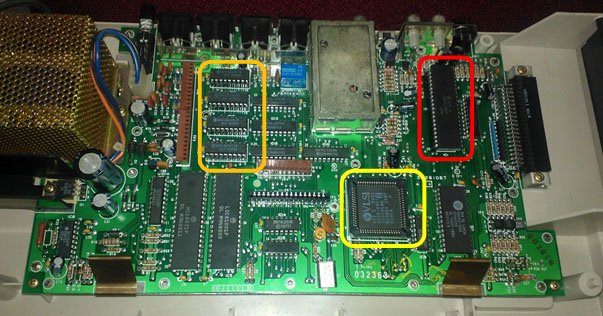
Color Computer 3 mother board sporting a 1987 GIME chip
The motherboard above is from an American made CoCo 3, and the GIME is a 1987 model. The parts are as described below:
- Circled in red - CPU (68B09 stock - this one is a 63C09EP; notice the socket installed)
- Just below the CPU is the ROM
- Circled in yellow - the GIME chip
- Circled in orange to the left - RAM chips. Note the brown headers - these are used for the various memory upgrades
- The two large 40 pin IC's below the RAM are the PIA chips
The black connectors on the back of the computer are for joysticks (2), serial port (1) and cassette port (1). There's also a video modulator, for connecting the CoCo 3 to a TV for video and audio thru a switchbox. To the right of the modulator are the composite video and audio out RCA jacks, which can be connected to any TV that can use these types of connections. Finally, under the right front of the CoCo 3 is the 9 pin RGB port (not shown) to connect the CoCo 3 to a compatible RGB monitor.
Alternatively, the RGB port on the Color Computer 3 can be connected to an adapter made by Roy Justus. This adapter allows the CoCo 3 to be connected to any monitor that uses VGA input, and provides a VERY sharp and brilliant display for the CoCo 3. You can see examples here.
From RGB to Modern Displays
2026 UPDATE: Roy Justus' adapter is now part of a much longer story. Later projects such as CoCoVGA provided modern video output solutions, while CoCoDV takes the idea further with a digital-video replacement approach for the CoCo family. These projects allow an original machine to remain in everyday use without depending on increasingly scarce period monitors.
There have been rumors of multiple board designs for the CoCo 3. I cannot say I've ever seen a different layout than the one below.
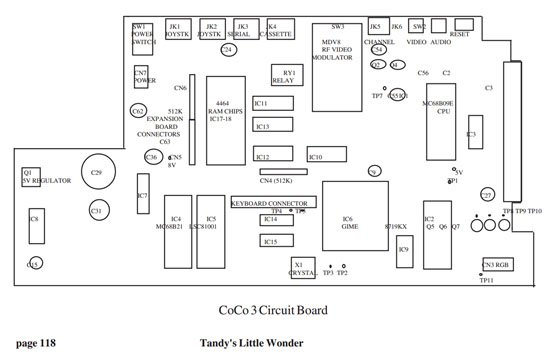
I own five CoCo 3's, all of which are American made units. However, Boisy Pitre of Cloud 9 has written a guide (posted below) to help distinguish American made CoCo 3's from the Korean made units (edited for brevity, you can see the whole guide here):
American vs. Korean CoCo 3
It is well known that over the course of the Color Computer's production, Tandy manufactured CoCos both overseas and in the United States. One of the more interesting comparisons can be made between the American and Korean models of the Tandy Color Computer 3.
Exterior Differences
If you are looking at a Korean and American CoCo 3 side by side, at first glance, it's not immediately noticeable that they are different. In fact, without the original packaging and box, they look identical. However, the packaging will give away a CoCo 3's country of origin.
Packaging
Korean CoCo 3's were shipped to Radio Shack stores in a predominately white box with red lettering and graphics. The picture on the front cover of the box shows the outline of a CoCo 3, and the sides of the box give a summary of features.
The later American CoCo 3 was packaged in a more attractive, sturdier white box with blue and red lettering and graphics. Featured on the front top of the box are two children sitting in front of a CoCo 3, while the sides depict graphics and lettering oriented
Outside Case
As mentioned earlier, the Korean and American CoCo 3 look virtually identical from the outside. However, there are a few minor clues which can tell the two apart without even opening them up (see the linked website for the details).
Interior Differences
Upon opening up both CoCo 3's, the differences are more striking internally.
The Motherboard
On both models of the CoCo 3, the actual motherboards have identical identification numbers, and appear to be exactly the same. The components, however, are slightly variant. (see the linked website for the details):
Other Internal Differences
One glaring difference internally has to do with the area where the keyboard rests on case. The Korean CoCo 3 has two small round black pads on either side of the pegs where the keyboard rests, in addition to a rectangular black rubber 'boot' at the bottom of the keyboard for support. The American CoCo 3 has none of these.
Nick provided the following information on the PAL CoCo3:
There was also a PAL version which had a slightly different layout and the inclusion of a RGB to PAL video daughterboard attached underneath the main board.
The reason for this is that the GIME only produced NTSC colour video and this doesn't produce colour on PAL based video systems such as in Australia.
The daughterboard took the GIME's RGB output and ran it through this board to generate PAL video. The other benefit to this is that the PAL composite output
has the same composite color palette as RGB. No separate NTSC composite palette as with US CoCo 3's.
Now that the intra-model comparisons are done, we can get to some of the myths and mysteries of the CoCo 3...
What market was the CoCo 3 designed to compete in? What computers were the CoCo 3's targeted competition? Several people have suggested that the CoCo 3 was intended as a competitor for the 68000 based machines like the Atari ST series and the Amiga (and probably Apple's Mac). In fact, Mark Siegel alluded to this in his interview with Nick:
Nick: Was the Color Computer 3 ever aimed at competing against the Amiga and Atari ST?
Mark: The Amiga had a lot of hardware thrown at it, and was a good machine. If I had had a budget like theirs, I am sure I could have blown them away but I suspect that the Amiga cost 3 times what the Color Computer 3 did to build. I was assured by Motorola that a 2MHz 6809 was more than a match for an 8MHz 68K. We had several big meetings on this issue, and we could have been sold the 68K for another advanced home computer at the time. We flew to Arizona to meet with them on this issue. At the time the two companies were working on advanced display controllers for the next generation Color Computer. It had 65K colors, sprites, display list generation at bit level, hardware line drawing and fills, and even a rudimentary z-buffer. But they could not get it to work.
From a layman's perspective, that's quite a bit to swallow ' a 6809 8/16 bit CPU being able to compete with a 68000 16/32 bit series CPU. I'm in no position to argue, but, that's quite a claim to make. The 65k colors and hardware sprites would have been awesome. The problem being one of affordability in my eyes: who could afford a CoCo with these features? Well, probably the same people who bought ST's ($599) and Amiga's ($699) at the time. As it turned out, the CoCo 3 was and is quite a capable machine in its own right at less than half the price of the competition.
There are also a large number of people who claim the 1.78MHz 6809 in the CoCo 3 will readily out-perform an 8088 in the IBM PC/XT running at 4.77MHz. True or not, it is evident talking to programmers that the 6809 is a MUCH better processor to learn to program for than the 8088, 6502 and many other processors of the day.
Can it display 256 colors? There's a rumored 256 color mode for the CoCo3; maybe it even qualifies for urban legend status at this point. Nick Marentes' Project Archive site has a detailed synopsis of the quest to find the missing mode, including an interview with a former Tandy employee who claims the mode is real. To date, no official mode has been found that can be turned on and off by the GIME chip that allows access to a true 256 color mode. However, some very creative folks have found a way to get the CoCo 3 to display approximately 256 artifact colors. The Christmas images I included at the end of last month's article were produced by these people.
One of the defining 'tests' of the late '80's computing era was the bouncing ball demo. One existed for virtually every computer of the time. One exists for the CoCo 3 as well; here's a link to it; and the CoCo 3 does this test quite well. Tandy/Radio Shack would never release sales figures, but, it stands to reason that the CoCo 3 had respectable sales figures. During that time, many people cut their teeth on the CoCo 3 as their first computer; used it every day for their business needs; and learned basic electronics and computer theory on this single-board 8-bitter. It's this writer's opinion that the CoCo 3 was quite a success, as it stayed in production until 1990 (it's cancellation was announced in October of 1990).
In fact, if it hadn't been for some interference from a new-hire at Tandy, it might well have lasted longer:
Nick: How did Tandy take the Color Computer 3? Was it a matter of "While it makes money, we keep selling it"?
Mark: It was doing very well until Tandy hired a VP from IBM to head the computer division. He only wanted to support PC's. He got Barry Thompson (the Color Computer buyer) and myself in a room and said "You can put perfume on a pig, but it's still a pig", and then told us that there would be no more Color Computer. A year later he was fired for messing up the product lines but the damage was done.
Internal Upgrades
Since the CoCo 3 was basically compatible with everything a CoCo1 or 2 could use for storage or expansion, I feel internal upgrades are about the only area that need covered. By internal upgrades, I mean RAM and CPU.
For RAM, there's a 512k RAM upgrade currently available from Cloud9. Back in the day, Disto Products made a 1 Meg upgrade as well. This website has information on several major CoCo 3 upgrades and projects, including an 8 Meg RAM upgrade and a wired-wrapped CoCo 3 (sounds like a fun winter project).
More Than 512K
2026 UPDATE: The original CoCo 3 shipped with 128K and Tandy officially supported a 512K upgrade. Third-party designers went considerably further. Disto, among others, produced commercial memory expansions reaching 1MB and 2MB, while still larger experimental designs have existed. It is useful to distinguish those commercial upgrades from one-off or experimental memory projects rather than listing all of them as equivalent factory-style options.
The clever part is that the CPU itself never stopped being a 64K-address-space processor. Larger CoCo 3 memory systems work by extending the bank-selection scheme around the GIME/MMU architecture, allowing software to move different physical memory blocks into the 6809's logical address space.
The other internal upgrade I'll address is the CPU. Remember, all Color Computers used the Motorola 68x09 CPU - for the CoCo 3 it was the 68B09E which was rated for 2MHz use. Hitachi produced the HD6309, a CMOS processor compatible with the Motorola 6809 architecture. The 6309 is 100% compatible with the 6809 while in 'emulation mode'. It is also 100% static device, meaning it will not lose it's internal state. This also means it can utilize an external DMA without the need to refresh every 14 cycles as the 6809 does.
However, the engineers at Hitachi were not content with leaving the design alone. They added the following to the design:
- Clock Speed - The 6309B is a 2 MHz version just as the 6809B is and has both internal and external clock versions (an example of the external clocked version is the 63C09E - the E at the end denotes an external clock). There's also a "C" version rated at either 3.0 or 3.5 MHz maximum clock rate. Several reports indicate that the 63C09 can be clocked at 5 MHz with no ill effects. Like the 6809, the Hitachi CPU comes in both internal and external clock versions (HD63B/C09 and HD63B/C09E respectively)
- Multiple Modes - On power up, the 6309 works identically to a 6809. However, with the proper code the 6309 will switch into 6309 Native Mode offering speed increases in the 30-50% range - depending upon the application.
- Additional Registers - There are two additional 8-bit accumulators, E and F added to the 6309. These can be concatenated to form a 16-bit accumulator called W. The existing 6809 16-bit accumulator, D, can also be concatenated with W to form a 32-bit accumulator Q.
- A "Transfer register" V - is only accessible via inter-register instructions; it's value is not cleared during a hardware reset, so it can maintain a constant 'Value', hence "V".
- 8/16-bit Zero register - called 0, this is provided for speeding up operations where a zero constant is used; the register always returns a zero, and writing to it has no effect.
- A new mode register 'MD' - handles the 6309's operating mode and operates as a secondary condition code.
- Additional Instructions - Most of the new instructions are modifications of existing instructions to handle the existence of the additional registers, such as load, store, add, and the like. Genuine 6309 additions include inter-register arithmetic, block transfers, hardware division, and bit-level manipulations.
You can find a full run-down of the 6309 secrets here
.The 6309 has been a very popular replacement CPU for the Color Computer user base. It's a direct replacement and with the proper code, can also increase the performance of the computer. There are numerous methods of swapping the CPU. Some folks piggy-back the new chip on top of the 6809, either hardwiring it for 6309 only or use a switch so they can change CPU's at will. Still, others prefer to clip out the 6809, soldering a socket in it's place and plugging a 6309 into the socket. The 6309's performance benefits really become apparent when running NitrOS-9.
2026 UPDATE: The HD6309 became far more than a curiosity. Products such as Burke & Burke's PowerBoost helped popularize the upgrade, and software authors learned to exploit the processor's native mode, additional registers, block-transfer instructions, hardware multiply/divide operations and other extensions. Modern NitrOS-9 and newer CoCo software continue to make productive use of the 6309 while retaining 6809 compatibility where practical.
The Years Since 1990 - And the Years Since This Article
Since 1990, the Color Computer 3 has enjoyed a long and fruitful life thru the talents of quite a number of enthusiasts. Below are just a few of those involved:
Glenside Color Computer Club - still meets regularly and hosts a yearly meeting called: The XXnd Annual "Last" Chicago CoCoFEST! You can read more about it here.
Cloud 9 - Mark Marlette and Boisy Pitre have developed some of the coolest CoCo hardware available. An IDE controller, SCSI controller, a PS/2 keyboard adapter and many more. Take a look at their website for many more products and more info.
Roy Justus - As mentioned above, Roy makes a killer RGB to VGA converter for use with the CoCo 3. It also works with an Atari ST (and probably other computers of the day) with the appropriate cable. (Roy no longer makes these)
Roger Taylor - Roger has been involved with the CoCo for many years. During this time he has authored quite a large number of programs, games and Windows based IDE systems for the CoCo (and other vintage machines) programmers to use for software development.
DriveWire4 - DriveWire4 website explains it best: DriveWire 4 is an award winning open source connectivity solution for the Tandy Color Computer. Aaron Wolfe considers this to be a community project - he started it and many others have contributed. (2026 update to the Sourceforge location - qbancoffee)
John Kowalski (a.k.a. Sock Master) - John's accomplishments on the CoCo are pretty much legendary. Some of his demos defy the conventional thinking about the machine's abilities and his Donkey Kong conversion is the best on any machine.
Pushing the CoCo 3 - Glen Hewlett
One of the more remarkable examples of modern CoCo 3 development comes from Glen Hewlett. Rather than simply writing games inspired by classic arcade machines, Glen has spent years studying original arcade hardware and software and adapting that behavior to the CoCo 3. His projects have included remarkably faithful conversions of arcade games such as Pac-Man and Defender.
The process can involve studying original ROMs and source code, using tools such as the MAME debugger to examine how the original arcade machine operates, translating code from processors such as the Z80 to the 6809, and replacing functions originally performed by specialized arcade hardware with routines designed around the CoCo 3 and its GIME. The result is much closer to converting the original arcade program than simply creating a CoCo game that looks like it.
Glen pushed the idea considerably further with Rick Dangerous, completed for the CoCo 3 in August 2026. Instead of limiting the project to a stock machine, this version requires a 6309 processor and 2MB of RAM. It uses a 256x200 16-color display, provides two simultaneous audio channels during gameplay and three during the title and splash screens, and was converted primarily from the XRick C implementation into CoCo 3 assembly language.

Rick Dangerous for the CoCo 3 - completed by Glen Hewlett in 2026
Projects like these illustrate an interesting change in Color Computer development. For decades the question was usually, "What can we squeeze out of a stock CoCo 3?" With 6309 processors, multi-megabyte memory expansions and forty years of accumulated knowledge about the GIME, another question can now be asked: "How far can the CoCo 3 architecture itself be pushed?" Remarkably, people are still finding out.
2026 UPDATE - STILL NOT DEAD
Thirteen years after this article was written, the CoCo 3 community has continued doing something more interesting than merely preserving old machines. New hardware, replacement hardware, storage systems, development tools and software continue to appear.
CoCoSDC brought convenient SD-card based disk-image storage to real Color Computers. DriveWire continued to make a host computer useful as storage and a communications server. Modern video projects such as CoCoVGA and CoCoDV addressed the increasingly awkward problem of connecting vintage machines to modern displays. Replacement and reimplemented hardware has expanded to memory boards, Multi-Pak-style expansion, disk controllers, serial hardware and other devices.
Gary Becker's CoCo3FPGA took another path entirely by implementing the CoCo 3 architecture in programmable logic rather than merely emulating it in software. That work later fed directly into the GIME-X project. CoCo3FPGA has also been ported to other FPGA platforms, demonstrating how thoroughly the architecture has been studied and recreated.
The software side never stopped either. Programmers continue to produce games, utilities, demos and operating-system improvements for both 6809 and 6309 systems. The CoCo 3 is therefore in the unusual position of being a 1986 computer for which genuinely new software and hardware are still being developed four decades later.
For a much deeper look at the people and projects that kept the entire Color Computer family alive, see the separate Keeping the CoCo Alive article on this site.
Wrapping It Up
Well, I did my absolute best to ensure the information presented here was accurate. If I've made a mistake, there are several in the CoCo Community whom I'm sure will let me know. There was a lot of research for this article; and lots of information provided by others. I'd like to thank the following people for their very timely and useful information:
Boisy Pitre/Mark Marlette: Thanks guys for letting me source the information regarding the American Vs. Korean CoCo 3 models.
Frank Swygert: Your book 'Tandy's Little Wonder' is an absolute treasure trove of useful information. Thank you for allowing me to use it as a reference.
Brian Wieseler: Thanks for allowing me to use photographs of your surviving Deluxe Color Computer development machine. Seeing the exterior, the prototype hardware inside and Advanced Color BASIC actually running adds an entirely different level of documentation to this part of the Color Computer story.
Nick Marentes: Thanks for allowing me to use information on your website, the interview you conducted with Mark Siegel and your commentary. Nick also has written a book named CoCoNuts - chock full of interviews he's conducted with people who helped make the CoCo what it is.
Dennis B'thory-Kitsz: Thanks for allowing me to use info from the CoCo Mailing list - not to mention running the list in the first place.
This article was not shorter than the others - by any stretch - which I thought it would be. There's lots of other areas about the CoCo 3 which could be discussed at length. The problem is I'm already at 19+ pages and more than 6,000 words in just this article. There are many more people who deserve credit that I simply do not have the room for. In future articles, I hope to address those areas I neglected in this one. As I sit here thinking about the last month, it dawned on me that there were only four days that I didn't do some type of work on this article. No wonder I didn't get to do that Sega article I had wanted - oh well, another time I guess.
If anyone has any questions or comments regarding the content of this article, please feel free to contact me either on the Retrogaming Times Forum, the comments box below, or at my email address at random.rodder at gmail dot com. Looking forward to next month, I have no clue what I'll do for an article. The CoCo 3 article required far more work than I expected and I'm pretty drained right now. In closing, I'll leave you with a little bit of wisdom from Mark Siegel regarding his opinion of the CoCo3:
Nick: Many Color Computer enthusiasts have these bad views of Tandy. What is your feeling on this?
Mark: In a lot of cases they are right, but the Color Computer community never sent articles to the major magazines about the machine. You know, enthusiasm is catching, but you have to pitch it before someone catches. The Apple II started by word of mouth. So I think both Tandy and the Color Computer community were at fault here.
Nick: How do you feel being the developer of the Color Computer 3?
Mark: I was pretty happy with the way it turned out. I'm not even sure in retrospect that I would have done anything much different. The Color Computer 3 cost under $100 to manufacture at the start. I defy anyone to show me a better price performance than this.
If you'd like to read the full interview, look for a copy of Nick's book, CoCoNUTS: Interviews with people who helped shape the "CoCo".
Some of the details about the 6309 came from the following Wikipedia article: http://en.wikipedia.org/wiki/HD6309.
This article first appeared in the January & February 2013 issue of Retrogaming Time Magazine
Extensively revised and expanded September 2026.
OK
