
One CoCo To Rule Them All? Not Hardly...
Greetings retro fans! I hope everyone is enjoying the holiday season. When we left off last month, we had just finished a discussion on the differences between the TRS-80 Z-80 based systems and the CoCo. Entire volumes could be written if we wanted to compare the architecture and design philosophy between the systems. For that discussion, I'll throw the 'boring flag' right now on that discussion, as it'd probably only interest engineers. Besides, a Model I, III, IV guru I am not, and when you get right down to it, there are plenty of differences between the CoCo models themselves to write about.
Below are the technical specs for the Color Computer upon it's birth in 1980:
- CPU: Motorola MC6809E, 8-bit
- Normal clock speed: approximately 0.895 MHz
- Data bus width: 8-bit
- Address bus width: 16-bit
- Standard RAM: 4K on the earliest machines, with 16K, 32K and eventually 64K configurations offered during the CoCo 1's life
- Maximum address space: 64K
- ROM: 8K Color BASIC; Extended Color BASIC added another 8K ROM on equipped systems
- Video: Motorola MC6847 Video Display Generator (VDG)
- Text display: 32 columns x 16 rows
- Graphics: multiple semigraphics and bitmap modes, including up to 256 x 192 monochrome and 128 x 192 color
- Display output: RF television output on North American models
- Ports: cassette, serial "bit-banger", two analog joystick ports, and 40-pin cartridge/expansion connector
- Storage: cassette; floppy disk available with an external controller and drive system
- Built-in language: Microsoft Color BASIC; Extended Color BASIC on appropriately equipped models
Memory
Video
Misc. Features
The Three Chips That Made a CoCo
The original Color Computer's personality came largely from three Motorola devices working together: the MC6809E CPU, the MC6847 Video Display Generator and the MC6883 Synchronous Address Multiplexer, usually just called the SAM. The SAM handled memory addressing and timing chores shared by the processor and video hardware, while the VDG generated the CoCo's familiar text, semigraphics and bitmap displays. Tandy's own technical documentation identifies these devices as central pieces of the machine's design.
The familiar CoCo CPU speed is approximately 0.895 MHz. The SAM also provided a faster clock selection of roughly 1.79 MHz. Programmers eventually learned to take advantage of the faster rate where the hardware allowed it, although it was not simply a matter of running every program at double speed; video and memory timing placed practical restrictions on its use.
Before It Was a CoCo
The Color Computer also has an interesting family history that was much less widely documented when I originally wrote this article. Its architecture grew out of Motorola and Tandy work on low-cost videotex terminals. The experimental Project Green Thumb terminal used an earlier MC3870 processor, but the later AgVision and Radio Shack TRS-80 Videotex designs moved to the 6809, MC6847 VDG and MC6883 SAM combination that would become the core of the Color Computer. When Tandy announced the CoCo in 1980, the internal modem disappeared and cassette, serial, joystick and cartridge/expansion connections turned the specialized terminal architecture into a general-purpose home computer.
Brief synopsis on model numbers:
The first CoCo to be released was model number 26-3001 with 4 K of ram (later upgraded to 16k). These can easy be identified in the wild by the TRS label on the left hand side and a small "4k" or "16K bubble on the top right hand side.
Known Model Numbers include:26-3001- 4K RAM with Color Basic, 26-3002- 16K RAM with Extended Color Basic
The second style, with larger release numbers, was the Center Label style and did not have a RAM badge on the top case. These units were ether 16 or 32 K.
Known Model numbers include: 26-3002A, 26-3003, 26-3004, 26-3004A, 26-3004B.
The very first TRS-80 Color Computer carried the 26-3001 model number. The machine was released in a battleship gray plastic case, with an 8K Microsoft BASIC interpreter (in ROM), chiclet keyboard and a whopping 4K of RAM. Upon release, the very first CoCo 1 had a suggested retail price of $399. Like many home computers of the day, the CoCo shipped with a TV modulator to hook it up to your television. The normal text display was 32 x 16 characters, with the familiar dark characters on a 'nuclear green' background. The CoCo also sported a 53 key 'keyboard', joystick, cassette and serial 'bit banger' ports on the back, as well as a 40 pin expansion slot on the right side.
Early versions of the CoCo could be upgraded to 32K, however, it was not an easy task as it required piggybacking two banks of 16K memory chips and adding a few jumper wires. Later revisions to the motherboard eliminated this upgrade. In fact, I have a 26-3001 (picture below) that was upgraded to 32K and Extended Color BASIC by a place in Davenport, Iowa. The 32K upgrade consists of eight socketed MN4164-15 dynamic RAM chips, and two jumper wires.
Later motherboard revisions removed the 4K RAM option; systems were upgraded to 32K with 64K memory chips which were supposed to be 'half bad' as a cost-cutting measure. The boards have jumpers marked HIGH/LOW to determine which half of the memory chip was good. The BASIC programmer was none the wiser, since in either configuration, 32K of memory was available.
The 26-3002 & 26-3003 models looked alike and were basically the same hardware; really the only difference in them was the amount of RAM � 16K and 32K respectfully. As memory production yields improved and costs went down, it's rumored that many, if not most 32K CoCo 1s were shipped with perfectly good 64K memory chips. In fact, clever coders began to write utilities and programs to take advantage of this 'extra' 32K.
Eventually the 32K CoCo was dropped entirely and only 16K or 64K versions were offered. All versions of the CoCo which shipped with just Microsoft Color BASIC could be upgraded to Extended Color BASIC by simply plugging a ROM into an empty socket provided on the motherboard. ECB offered many enhancements to the BASIC interpreter, making it much easier to program than most other computers of the day.
Below are two machines from my collection:
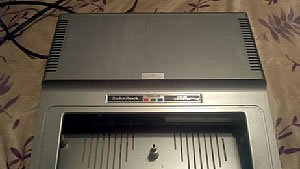
This unit is a 26-3004 - one of the last generation CoCo1s. It has 64K, and as purchased from eBay, had a CoCo3 keyboard. Notice the case-mod from the very poor packing the seller did.
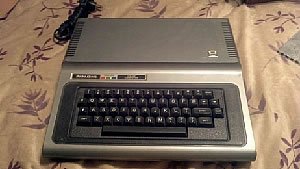
This unit is a 26-3001 - first generation CoCo1. It has a 32k upgrade and an aftermarket keyboard. I'm not sure of the model of the keyboard, but, I think it's a Mark Data SuperPro keyboard. It has a really good feel to it and is easy to type on.
It's easy to see the cosmetic differences between the two models. The outside isn't the only place where differences existed. Radio Shack revised and cost-reduced the CoCo 1 motherboard repeatedly during its production life while keeping the basic software and peripheral environment remarkably consistent. Today, surviving Tandy service manuals and schematics make it much easier to trace those changes, including the substantially redesigned 26-3004 board shown below.
One Computer, Many Motherboards
The words "CoCo 1" can therefore describe machines that look nearly identical from across the room but are quite different once the case is opened. RAM arrangements, component placement and the amount of discrete circuitry changed as Tandy refined the design and reduced manufacturing cost. That evolution is part of what makes collecting the early Color Computers interesting: the model name stayed put while the hardware underneath it kept evolving.
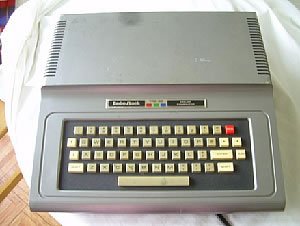
The TRS-80 Color Computer models 26-3002 and 26-3003:
The second generation Color Computer models are easily spotted: The TRS-80 nameplate is centered above the keyboard, and there is no 'RAM button' mounted to the top case. Additionally, the keyboard surround is no longer flat black.
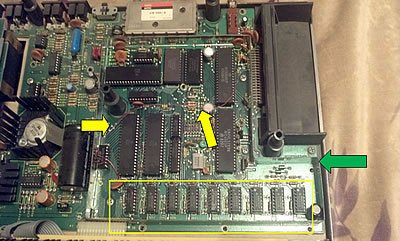
Above is the motherboard of the 26-3001. Notice the jumper wires (yellow arrows) added to complete the 32k upgrade.
Also, for comparison to the 26-3004 picture coming up, pay close attention to the layout of the board. That green arrow points to the outline of
the RF shield the CoCo1s were sportin' back in the '80s. Those are the DRAM chips in the yellow box, taking up some real-estate.
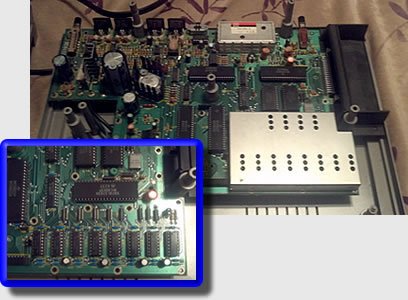
Here's the 26-3004 motherboard. Notice the difference in the layout ? They're the same machine, run the same software and use the same hardware and peripheral devices; advancements in the manufacturing process lead to a more optimized PCB.
The area underneath the RF shield (highlighted in blue), where the DRAM chips reside, is much more compact and no more jumpers.
The White CoCo
That about tells the story for the CoCo1. However, I'd be remiss if I didn't mention the 26-3003b CoCo model - CoCo the White. Okay, so it doesn't sound as impressive as 'Gandalf the White', but, it IS a 64K CoCo1 built into a white case, with the bonus of an improved keyboard. Ironically, many still scratched their heads at this keyboard since it looks like someone put it in an oven and melted the keys. Seriously. It's still referred to as 'the melted keyboard' by CoCo fans world-wide.
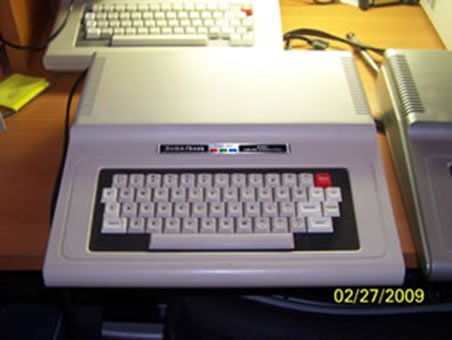
The TRS-80 Color Computer model 26-3003b:
The second generation Color Computer sold in a white case with a funky 'melted' keyboard. As with the other 26-3002 & 26-3003 lines, the TRS-80 nameplate is centered above the keyboard, and there is no 'RAM button' mounted to the top case. This model was sold only with 64k RAM. About this time Radio Shack also offered peripheral devices in white as well. I purchased this unit off of eBay in 2008 for $42.00. Still don't even know if it works.
The Clone Wars...
Well... I guess I'm not yet done with the CoCo1. You see, Radio Shack, in its infinite wisdom, decided the CoCo was such a success they should attempt to duplicate its sales volume in another venue... department stores. Regardless of the venue, it's still a CoCo1. In a tan case. With vents all across its back. And a chiclet keyboard.
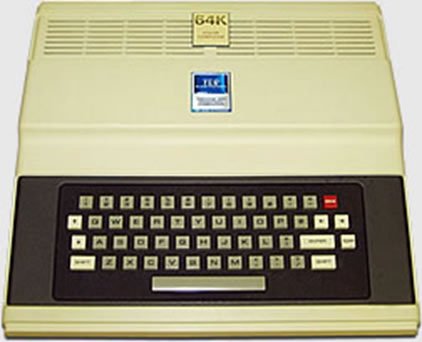
The TDP-100 was Tandy's alternate-market version of the Color Computer, sold under the Tandy Data Products name rather than as a Radio Shack TRS-80. It was essentially a repackaged CoCo 1 aimed at sales channels outside the traditional Radio Shack store network. The TDP-100 was sold with either 16K or 64K of RAM and Extended Color BASIC, ran CoCo 1 software and used the same basic CoCo peripherals. Underneath the different case and badge, it remained very much a Color Computer.
For a more in depth look at the CoCo1 line, Glen VanDenBiggelaar once did a complete tear-down of a CoCo 1 (and 2 and 3), and posted it at his CoCo Lounge site back in 2005. Unfortunately he's no longer active in the CoCo community as he's now chasing around Amiga's as a hobby. He has not closed the CoCo Lounge, so, if you are interested in the CoCo, his site is a good place for more in depth information than is possible in magazine articles (I have since learned Glen has passed - R.I.P. Glen).
Dragons and computers?
Whew... that's a lot of CoCo 1 options. What's that? More CoCos? You're kidding, right? Um... no. Well, sort of. Maybe. The Dragon 32, introduced by Dragon Data in the U.K. in 1982, is often called a CoCo clone, but close cousin is a better description. Both computers were built around the same basic Motorola 6809E, MC6847 VDG and MC6883 SAM architecture, which explains their striking similarities, but they were not identical machines.
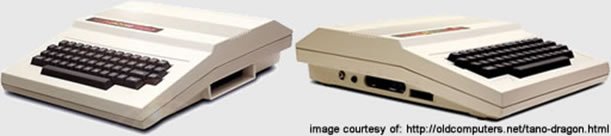
The similarities made a surprising amount of software portable between the two families, but compatibility was not absolute. The keyboard map and ROM routines differed, tokenized BASIC programs were not directly interchangeable, and machine-language programs that called ROM routines often needed modification. ASCII BASIC listings were much easier to move between the machines. The Dragon 64 later added 64K of RAM and a true serial interface, something the CoCo's built-in serial "bit-banger" did not provide. Tano later marketed Dragon machines in the United States, but the Dragon never approached the CoCo's U.S. presence.
Are we done yet...?
There are two more CoCo clones out in the wild, that deserve mention here. The first one I'll mention is the Prologica CP-400 (below left). While its case design was an attractive, yet radical departure from the afore mentioned machines, its internals were not. My next statement might be predictable, but, I'm going to say it anyway; I don't think I'd like typing on that keyboard...
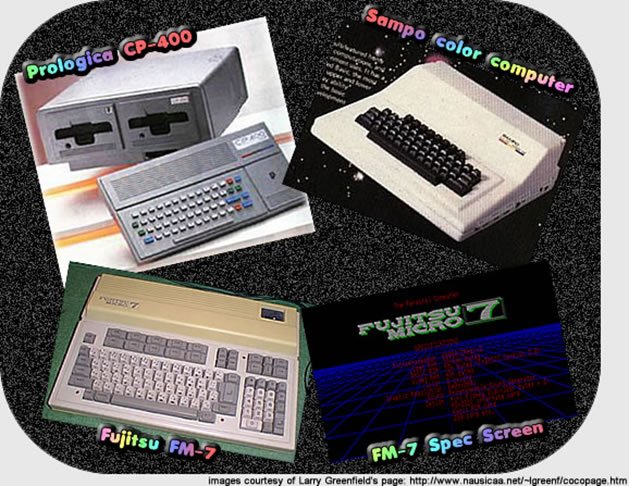
Above right, we have the Sampo color computer. As you can see, it's... different. Not much is known about the beast, except it has same basic feature the original CoCo, with the addition of true lowercase characters and a REAL keyboard; both lacking in the original CoCo. Well, I cannot speak for the other computers of the day, however, the TRS-80 Color Computer was represented by several variations of its own. When you include the clones, it becomes easier to understand why the CoCo was confused with so many other model - quite literally, it had lots of siblings. And clones...
Elsewhere in the 6809 World...
One machine I included in the original version of this article deserves a correction: the Fujitsu FM-7 is fascinating to a CoCo fan because it also belongs to the wider 6809 world, but it should not be described as CoCo compatible. The Japanese FM-7 used a pair of 68B09 processors - one as the main CPU and another devoted to graphics work - and represents a very different computer architecture. Its 6809 connection, and the broader ecosystem of operating systems and development tools surrounding that processor family, still make it an interesting relative in spirit, just not a CoCo clone.
Doing the research for much of this article, as well as some business obligations, kept me from having the time I needed to write any reviews of some CoCo games as
I had planned. In lieu of that, I'll give a link to Curtis Boyle's web site of CoCo gaming.
The following are pictures of some CoCo games I'll be reviewing in the future. They come from Curtis' web site:
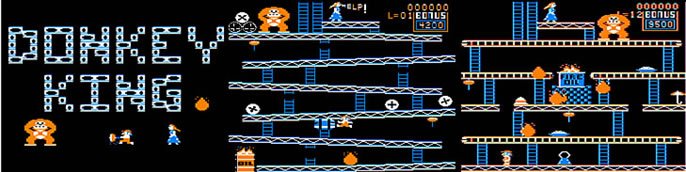
This was obviously a clone of Donkey Kong; it also had all four screens - a claim many systems that had licensed versions couldn't make.
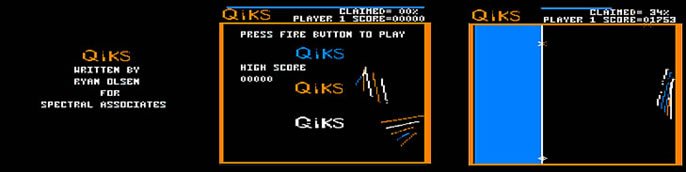
This game is called Qiks, and is a clone of the arcade game Qix, I remember being quite addicted to this game.
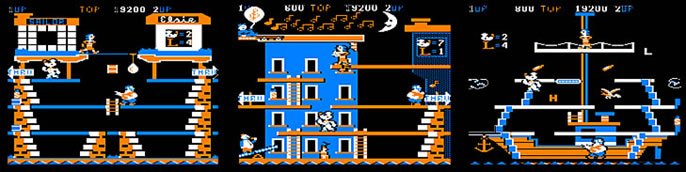
This Popeye clone, called Sailor Man was an outstanding game and had all of the elements of its arcade counterpart.
In closing, I'd like to give you a glimpse of next month's article - which is part three, and focuses on the CoCo2. It'll be a much shorter article, so I should have time to do an actual game review for a change. For February's issue, I'll be discussing the CoCo3, what made it different from the other models, and its special modes.
Boy... were the above predictions dead wrong...
The CoCo 1 in 2026
When this article first appeared in 2011, the CoCo was already a thirty-year-old computer. Somehow, another decade and a half has gone by and the little gray machine still refuses to become merely a museum piece.
Modern storage has changed what it is like to use a CoCo dramatically. Devices such as the CoCoSDC allow disk images to live on SD media, while DriveWire lets a CoCo use a modern host computer for virtual disk storage and other services. Newer network-oriented projects have pushed the idea even further. None of this changes the machine at its core; it simply makes living with original hardware far easier than juggling stacks of aging floppy disks and cassette tapes.
Video hasn't been forgotten either. Projects such as CoCoVGA and CoCoDV provide modern display solutions for original machines, while replacement parts, memory hardware, cartridge boards and newly manufactured accessories continue to appear from people in the CoCo community.
Software development never really stopped. Modern assemblers, cross-development tools and emulators let programmers write and test 6809 software on current computers and then run it on the real thing. XRoar, for example, remains an actively maintained emulator for the Color Computer, Dragon and related 6809 systems. Just as important, people continue to write new games, utilities and operating-system software for hardware Tandy introduced in 1980.
That may be the most remarkable part of the CoCo story. More than forty-five years after the first 4K Color Computer appeared, people aren't simply preserving these machines on shelves. They're repairing them, expanding them, designing new hardware for them and still finding new things to make a roughly 0.895 MHz 6809 do.
For a much deeper look at that modern hardware story, see the companion article Keeping the CoCo Alive, which follows the decades of third-party development that carried the Color Computer far beyond anything Radio Shack originally imagined.
This article was first seen in the December 2011 issue of the Retro Gaming Times Magazine.
Updated info added 12/3/2012
Extensively revised and expanded September 2026.
OK
